
About us
Meet Neurosurgeon Brain Specialist Spine Surgeon Researcher & Academcian Dr. Prasanna Patankar
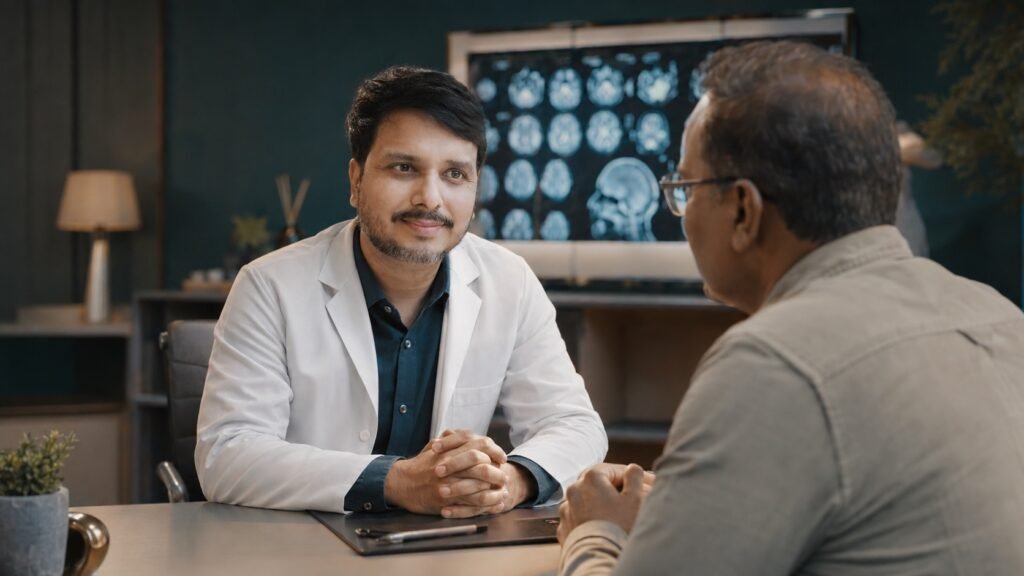
Expertise with Empathy
Dr. Prasanna Shrikant Patankar is a consultant neurosurgeon with more than 25 years in medicine and more than two decades across surgery and neurosurgery. it started in the corridors of a government medical college in Kolhapur, watching the quiet, extraordinary work that happens when the human brain is exposed under operating lights. Something clicked. Not romantically practically. He saw a discipline that demanded everything a doctor could give, and he decided to give it.
Experience You Can Trust.
Care That Listens.
To build a trusted, internationally connected neurosurgical practice where complex decisions are made with precision, evidence, ethical judgement and respect for every patient’s circumstances.
To help patients and families understand complex brain and spine conditions, evaluate reasonable treatment pathways and move through consultation, surgery and recovery with clearer information and coordinated support.
Precision was not inherited.
It was trained.
From surgical training in Maharashtra and demanding neurosurgical environments in Mumbai to advanced clinical exposure in Japan and Germany, Dr. Prasanna Patankar's journey has been shaped by disciplined training, continuous learning and patient-centred decision-making.
Chapter 01 The Training — Where Precision Was Forged
Dr. Patankar's medical journey began at D.Y. Patil Medical College, Kolhapur, where he completed his MBBS in 2000.
He then pursued a Master's in General Surgery at Dr. V.M. Medical College, Solapur, completing his MS in 2003.
General surgery created the foundation. Neurosurgery became the destination.
He went on to complete his DNB in Neurosurgery at Lokmanya Tilak Municipal General Hospital, Sion, Mumbai — a demanding trauma and tertiary-care environment.
His training required more than technical skill. It demanded clinical judgement, rapid decision-making, discipline and the ability to manage complex situations under pressure.
His early neurosurgical experience included brain tumours, vascular conditions, head injuries and complex spinal trauma.
Chapter 02 International Fellowship — Japan & Germany
Dr. Patankar continued seeking exposure to different neurosurgical approaches and advanced surgical techniques.
This pursuit took him from India to Japan and later to Germany.
Fujita Health University
During his clinical fellowship, Dr. Patankar gained exposure to meticulous microsurgical approaches including techniques related to aneurysm clipping, AVM surgery and microvascular neurosurgery.
Functional Neurosurgery
His international training later extended into functional neurosurgery, including exposure to deep brain stimulation techniques used in selected movement disorders.
Chapter 03 From High-Volume Trauma to Advanced Tertiary Care
Dr. Patankar's professional development moved through some of Mumbai's busiest public and private tertiary-care environments.
His work exposed him to emergency neurosurgery, elective brain surgery, spinal trauma, neuro-oncology, vascular emergencies and multidisciplinary tertiary care.
2005–2009
2013–2018
LTMGH, Sion Hospital — Mumbai
+
2009–2012 Kokilaben Dhirubhai Ambani Hospital — Mumbai +
Consultant SevenHills Hospital — Mumbai +
Clinical P.D. Hinduja National Hospital — Mumbai +
Chapter 04 A Deliberate Move Toward the Patients Who Needed Him
In 2018, Dr. Patankar made a significant professional decision.
Instead of limiting his practice to Mumbai's established private healthcare ecosystem, he moved to Sahyadri Super Speciality Hospital, Karad to bring experienced neurosurgical care closer to patients outside metropolitan centres.
A step toward making experienced neurosurgical consultation and treatment available closer to communities that needed it.
Chapter 05 The Patient Is Not a Case Number
Dr. Patankar believes a consultation should do more than produce a prescription or surgical date.
Before an intervention, he places importance on helping patients and families understand the diagnosis, available options, potential risks and proposed plan.
Complex neurosurgical decisions can be overwhelming. Clear communication is therefore not separate from care — it is part of care.
Understand the problem.
Review the history, neurological findings, investigations and imaging before deciding what intervention — if any — is appropriate.
Explain the decision.
Patients and families should understand what is being considered, why it is being considered and what questions still need to be answered.
Care for the Person.
Chapter 06 Research, Teaching & Academic Neurosurgery
Dr. Patankar's professional work extends beyond the operating room into academic medicine, research and teaching.
He has authored or contributed to seven peer-reviewed publications in journals including the British Journal of Neurosurgery, Neurology India and Indian Journal of Neurotrauma.
His research interests have included near-infrared spectroscopy for haematoma detection, stereotactic aspiration of haematomas, stem-cell research in spinal cord injury and endoscopic approaches to hydrocephalus.
His academic engagement also includes teaching undergraduate, postgraduate and superspeciality students through seminars, case discussions and journal reviews.
His professional participation has included neurological and neurosurgical conferences, academic meetings and specialist workshops in India and internationally.
Chapter 07 Qualifications at a Glance
Awards & Recognition
A complex diagnosis deserves a clear conversation.
Whether you are considering neurosurgery, reviewing an existing treatment recommendation or would like another specialist opinion on your scans and reports, you can request a consultation with Dr. Prasanna Patankar.